Wednesday, May 6, 2015

Quick Notes on a May Toddler Tales and Trails

Today’s theme was birds and their nests and how to watch for signs of birds nesting.  At this time of the year slow down and watch around you.  Do you notice birds flying back and forth to one tree, a bird house or to nest you may have just noticed in the eave of a house?  Use your ears: Listen.  Are little birds tweeting?  Are the parent birds and perhaps supporting family members busily bringing food back to their babies? 

I was unable to get a hold of the story I had planned on reading today Have You Heard the Nesting Bird however we did read a few fun non-fiction stories  Birds by Kevin Henkes and Little Owl Lost by Chris Haughton.  We also looked at pictures of birds nests in the book Urban Roosts: Where Birds Nest in the City by Barbara Nash. Then as we hiked we did a short nest making activity and game where we made paper bag nests.  We hid them in nearby bushes and pretended they were our nests and we needed to feed our babies- gathering pretend worms and insects.  Finally we went on a hike looking for bugs. We looked in the bark of several trees.  We shook the low branches of a fir tree onto a sheet.  

So many books.  So many trails. So many birds.  So many songs.  So many activities. I am looking forward to next month already!

Friday, May 1, 2015

Maintaining Creative Play in a Society of Sports and Asphalt

I have been working on a local playground renovation project for the past three years.  I went into it believing that we could create a school playground with natural play elements that fostered nature connection and creative play.  It turns out that we will add more asphalt and the natural aspects of the playground will be “add ons”- only if we have enough money.    

In my ordering of things I would say lets do the most “green” infrastructure to the field and playground as we can.  Then "add on" the extra asphalt.  But community process takes precedence and a track and concrete is what the people want.  In fact when we walked door to door surveying people many said, "fill the field holes, add a track, get new play equipment." We have gotten generous grants to achieve these but I can help but feel a little bit disappointed that we will not be creating a playground that is a leader in naturalization. 

Meanwhile, our twin boys are now in kindergarten playing on concrete daily.  They are also getting older and their play has moved from merely tactile curiosity and simple play to much more complex rule based play.   School has meant that the boys are also into sports.  Not that the whole school does sports, however sports are giving them an avenue to connect with their classmates. As a family we are supporting of this new endeavor.  They have joined a  great and fun T-ball team.  Also, our hours of outdoor play each day now include at least an hour or basketball, soccer, or baseball. 
  
I try to keep our sports play slightly creative by using non standard equipment.  Our basketball court is a dirt patch.  Our baseball field is on the slope of a hill and sliding into second, means you really are sliding downhill.  We use all sorts of balls: soft, plastic, leather, wool, hollow and empty…whatever we can find and which makes the most sense for the conditions.  Weather is a big factor, but rain doesn’t stop us.   In our own way I think this play is actually fostering flexibility, creativity, strength and connection to nature- as the boys often need to climb the plum tree to retrieve their whiffle ball.  Or perhaps they need to hop through the mint and sage to retrieve a ball.   Our yard allows this- although their playground at school where they spend another hour outside a day doesn’t- and probably won’t ever allow this non- formal play.  


My boys also have drifted from the puttering and open ended play they once did regularly.  They now need more assistance in getting into the flow of merely creative play activities such as playing restaurant, exploring mud pits, sustained story making with friends and minimal toys. I realize that our society isn’t set to practice this play- although in some children may carry it forth better than others.   So I am working on it. I am trying to add quiet elements of intrigue to the yard: piles of sticks, mounds of soil, a hammock for lounging, and most importantly I am trying to give the boys time.   The urban-life surrounds us & a small yard is not going to be able to keep the kids engaged for long- but I am striving for that.  I am also striving to help with nearby green spaces becoming areas that our children can explore & keep connected to nature & creativity.  
Monday, April 6, 2015

Activities for Spring Festivities


I wanted to share a collection of ideas for spring gatherings.  I am an advocate of getting children outside as much as possible & I love to provide opportunities for open ended play some children appreciate having activities to get them started in their outdoor explorations.   So ways to get the children in to offbeat parts of the yard or garden is to add art to playtime.

Here are some activities that we have had success with recently:

  • painting bird houses (actual ones or garden decorations)
  • pine cone bird feeders and then give kids an opportunity to hang them
  • scavenger hunts that lead from clue to clue 
  • chalk time- can the kids make a giant sidewalk mural
  • bird nest “cookies” which are little rings filled with natural items that birds might want to incorporate into their nests. 
  • loose parts for inventing games - these may be, plastic lids, balls, or pinecones & other natural materials given time kids will surely invent ways to play with them 

Friday, March 20, 2015

First Day of Spring:

Today I was an Talking Oak Tree for the Seward Park Audubon.  I love being a “talking tree” and taking students into the woods to experience the forest.  Of course, I only was able to do a small number of the activities I had planned for as the school bus was late as well as in nature you have to plan for discovery that may lead you in new directions.

After starting off with an opening song.  We walked the nature trail and looked for signs of spring. We also discussed different ways to identify trees: by their bark and by their leaves.  We noticed the properties of the trees and described them with color words and texture words.  Later I read them a poem about who lives in an Oak Tree- found in the Growing Up Wild Curriculum.  We also looked at the seeds of an oak tree and seeds of a douglas fir tree. In order to explore the woods as much as possible we played “run and touch.”  It was beautiful to see the kindergarten teacher add to our activities.  When we got up from the mat she had the kids sing a song about an acorn that becomes a tree.  The class was all smiles and wonder.  

Finally we gathered around a young sapling and I told the children that this tree may have been planted by a young child and that they could come with their families to plant trees in the park.  If I had more time I might of shared my latest favorite oak tree story: Jaime y las bellotas by Tim Bowley and Ines Vilipi. Or in a longer unit: Seeds of Change by Jen Cullerton Johnson, ill. by Sonia Lynn Sadler  which is a book about Wangari Maathai.

What a lovely way to celebrate the first day of spring!

Monday, March 16, 2015

Bird notes: nesting time

A chickadee was flying in and out of our birdhouse today. If a pair chooses to nest in our birdhouse- this will be the third year in a row. I do clean it out after each season, hoping to keep it a healthy home. Our birdfeeder seems to keep a healthy invitation to visit our yard and lately the sunflower seeds have been enjoyed by a steady stream of juncos, goldfinches, chickadees and a towhee bird.

This seems a bit early for nesting, but the sun had been out for weeks and bird activity very high. Plus the cherry trees that surround our front yard have buds that look like they could at any moment burst open. Daffodils have been out for two weeks and tulips that get full sun are flowering already.

‘Salamander Search’ a success at West Seattle’s Camp Long

I love that we have salamanders in our urban parks. I want to learn more about them.  It reminds me to pull out some of my favorite salamander books. The Salamander Room and Big Night for Salamanders. 

http://www.seattletimes.com/photo-video/salamander-search-a-success-at-west-seattles-camp-long/

Thursday, March 5, 2015

School Gardens

The Reason for Gardens at Schools.

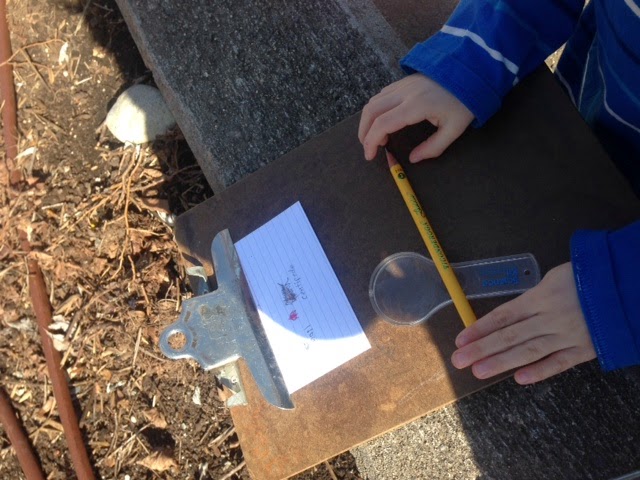
There are so many reasons that every school should have a garden, but perhaps the most important is that it takes learning outside and makes it absolutely meaningful.  Today the Garden Teacher at our school had an excellent lesson of searching through leaf litter for critters/ bugs!  The children loved it.  They loved lifting up leaves and searching for what had been hidden from their eye.  Then they used their observation skills to make scientific drawings.  

The classroom was abuzz with excitement as the kids went about uncovering hidden creatures, sharing their finds with one another, asking questions and trying to identify what it was they had discovered.  Then they drew their pictures for the classroom display.  It was joyful learning.

I taught life science units many years, however no terrarium or aquarium seems to compare to what we find outside in healthy garden beds or a healthy forest.  Time and time again I have led kids to just peek at what is undercover and they are amazed.  Some kids identify with the pill bug, others like the snails,worms,  the centipedes or millipedes, but whatever it is they are excited!

I am so thankful for our school garden and garden teacher.